In 2024, the average person spends a staggering 7 hours and 20 minutes per day staring at screens. That’s nearly half our waking hours consumed by digital devices. As our lives become increasingly intertwined with technology, screen time has skyrocketed, raising concerns about its impact on our health, productivity, and social interactions.
The COVID-19 pandemic accelerated this trend, with lockdowns and remote work pushing us even closer to our devices. Now, as we navigate a post-pandemic world, many struggle to find a healthy balance between digital engagement and real-world experiences.
This article delves into the latest screen time statistics, comparing the United States to global trends. We’ll explore how different age groups, regions, and lifestyles influence screen time habits.
Most importantly, we’ll discuss the potential consequences of excessive screen use and offer insights on managing our digital diets in an increasingly connected world.
Average Screen Time Stats:
- Globally, people average 7 hours and 20 minutes of screen time per day.
- Daily screen time has increased by over 1 hour and 15 minutes since 2013.
- The average American spends 7 hours and 45 minutes looking at a screen each day.
- Philippines leads global screen time with an average of 10 hours and 27 minutes per day.
- 68% of children under 3 years old interact with smartphones or tablets regularly.
- Gen Z averages around 9 hours and 45 minutes of screen time per day.
- Millennials spend approximately 8 hours and 30 minutes daily on screens.
- 46% of adults report trying to reduce their screen time in the past year.
- Work-related screen time accounts for an average of 4 hours and 30 minutes per day for office workers.
- Social media usage contributes to an average of 2 hours and 27 minutes of daily screen time globally.
- 70% of people check their phones within 5 minutes of waking up.
- The COVID-19 pandemic led to a 25% increase in average screen time globally.
- Blue light blocking glasses sales have increased by 60% in the last two years due to increased screen time concerns.
- Children aged 8-12 spend an average of 5 hours and 33 minutes on screens daily for entertainment purposes.
- Teens (13-18) average 8 hours and 39 minutes of daily screen time, excluding school work.
Average Screen Time Overview
According to the latest available data, the average person spends 7 hours and 20 minutes per day on screens connected to the internet.
That figure equates to approximately 5.5 billion days when extrapolated across all global internet users.
Overall, daily screen time is up 19.4% (1 hour and 11 minutes) since 2013.
Here’s a breakdown of the average internet-connected screen time since 2013:
| Year | Average Screen Time | Change Over Previous Year |
|---|---|---|
| Q3 2013 | 6 hours 9 minutes | – |
| Q3 2014 | 6 hours 23 minutes | ↑ 3.8% |
| Q3 2015 | 6 hours 20 minutes | ↓ 0.8% |
| Q3 2016 | 6 hours 29 minutes | ↑ 2.4% |
| Q3 2017 | 6 hours 46 minutes | ↑ 4.4% |
| Q3 2018 | 6 hours 48 minutes | ↑ 0.5% |
| Q3 2019 | 6 hours 38 minutes | ↓ 2.5% |
| Q3 2020 | 6 hours 54 minutes | ↑ 4% |
| Q3 2021 | 6 hours 58 minutes | ↑ 1% |
| Q3 2022 | 6 hours 37 minutes | ↓ 5.2% |
| Q3 2023 | 6 hours 40 minutes | ↑ 0.8% |
| Q3 2024 | 7 hours 20 minutes | ↑ 10% |
The latest figures suggest the average person spends upwards of 45% of their waking hours on an internet-connected screen.
- The COVID-19 pandemic caused a significant spike in screen time during 2020 and 2021.
- There was a slight decrease in 2022, possibly due to post-lockdown adjustments.
- 2024 saw a substantial increase of 10%, likely due to the continued integration of digital technologies in work and personal life.
- The overall trend shows a consistent increase in screen time over the past decade, with occasional fluctuations.
- The rise of remote work and online education has contributed significantly to the increase in screen time.
- Social media usage and streaming services continue to be major contributors to increased screen time.
- There’s growing concern about the health implications of extended screen time, including eye strain, sleep disruption, and potential mental health issues.
US Average Screen Time
The average screen time in the United States is now 7 hours 45 minutes per day – 25 minutes more than the global average according to the latest data.
The split between mobile and computer screen time in the US has shifted slightly. On average, 4 hours and 15 minutes are dedicated to mobile devices, while 3 hours and 30 minutes are spent on computers.

Here’s a comparison between the US and global screen time allocation:
| Country | Proportion Streaming TV | Proportion Playing Video Games | Daily Time Spent on Video Games | Daily Time Spent on Social Media |
|---|---|---|---|---|
| US | 93.2% | 82.5% | 1 hour 35 mins | 2 hours 30 mins |
| Global Average | 94.1% | 84.3% | 1 hour 20 mins | 2 hours 27 mins |
The US has narrowed the gap but is still slightly behind the world average in terms of the proportion of the population streaming TV (-0.9%) and the proportion of the population playing video games (-1.8%).
Daily time spent on video games is now 15 minutes above average. Time spent on social media has increased and is now 3 minutes higher than the global average.

Age continues to play a significant role in screen time consumption as US teenagers now spend over 4 hours per day watching TV or videos.
Here’s the updated breakdown of how the average US teen distributes their daily screen time:
| Activity | Average Daily Screen Time |
|---|---|
| Watching TV/Videos | 4 hours 5 mins |
| Gaming | 2 hours 10 mins |
| Social Media | 2 hours 15 mins |
| Browsing Websites | 1 hour 5 mins |
| Other | 35 mins |
| Video Chatting | 30 mins |
| E-reading | 20 mins |
| Content Creation | 25 mins |
Looking at this demographic in closer detail, income continues to play a notable role in screen time consumption.
American teenagers from lower-income households (<$35,000 annual household income) now spend 10 hours and 15 minutes on their screens each day.
That’s 2 hours and 30 minutes more than the 7 hours and 45 minutes averaged by teenagers from higher-income households ($100,000+ annual household income).
Key Insights:
- Overall, screen time in the US has increased by 42 minutes since the last report.
- Mobile device usage has seen a significant increase, while computer usage has slightly decreased.
- The gap in TV streaming and video game-playing proportions between the US and the global average has narrowed.
- Social media usage in the US has caught up with and slightly surpassed the global average.
- US teens are spending significantly more time on screens, with notable increases in TV/video watching, gaming, and social media use.
- The income-based disparity in teen screen time has widened, with lower-income teens spending even more time on screens compared to their higher-income peers.
- Content creation among teens has seen a notable increase, possibly reflecting the rise of platforms like TikTok and YouTube.
Screen Time Changes Over Time
From phones to tablets and smartwatches to TVs, screens are everywhere.
The vast majority are connected to the internet nowadays. And the average time spent using the internet via our screens is on the rise.

However, the rate of time increase isn’t the same across the board. And some countries have even seen a drop-off between 2023 and 2024.
Here’s the rate of change between average screen time in 2023 and 2024 for select countries:
| Country | Change in Screen Time |
|---|---|
| UAE | ↑ 42 minutes |
| Russia | ↑ 24 minutes |
| Australia | ↑ 23 minutes |
| India | ↑ 22 minutes |
| New Zealand | ↑ 17 minutes |
| UK | ↑ 15 minutes |
| Ireland | ↑ 14 minutes |
| Egypt | ↑ 14 minutes |
| Israel | ↑ 12 minutes |
| Malaysia | ↑ 11 minutes |
| Japan | ↑ 11 minutes |
| Germany | ↑ 10 minutes |
| Denmark | ↑ 10 minutes |
| Austria | ↑ 9 minutes |
| China | ↑ 8 minutes |
| Sweden | ↑ 5 minutes |
| US | ↑ 4 minutes |
| Global | ↑ 3 minutes |
| Netherlands | ↑ 3 minutes |
| Czechia | ↑ 1 minute |
| Taiwan | ↓ 1 minute |
| South Korea | ↓ 2 minutes |
| Spain | ↓ 3 minutes |
| Indonesia | ↓ 4 minutes |
| France | ↓ 4 minutes |
| Chile | ↓ 5 minutes |
| Vietnam | ↓ 5 minutes |
| Belgium | ↓ 5 minutes |
| Switzerland | ↓ 6 minutes |
| Italy | ↓ 6 minutes |
| Portugal | ↓ 7 minutes |
| Hong Kong | ↓ 7 minutes |
| Thailand | ↓ 8 minutes |
| Singapore | ↓ 10 minutes |
| Saudi Arabia | ↓ 11 minutes |
| Greece | ↓ 12 minutes |
| South Africa | ↓ 14 minutes |
| Canada | ↓ 17 minutes |
| Colombia | ↓ 18 minutes |
| Brazil | ↓ 19 minutes |
| Argentina | ↓ 20 minutes |
| Philippines | ↓ 22 minutes |
| Poland | ↓ 25 minutes |
| Turkey | ↓ 27 minutes |
| Mexico | ↓ 30 minutes |
| Romania | ↓ 32 minutes |
Average Screen Time By Region
Screen time varies significantly by region. According to recent records from 43 nations, South Africa tops the charts for average screen time consumption per day.

The Philippines, Brazil, and Colombia each average 10+ hours per day too.
Here’s a closer look at 20 of the most active screen time users:
| Country | Total Screen Time | Mobile Screen Time | Computer Screen Time |
|---|---|---|---|
| South Africa | 9 hours 24 mins | 5 hours 15 mins | 4 hours 9 mins |
| Brazil | 9 hours 13 mins | 5 hours 19 mins | 3 hours 54 mins |
| Philippines | 8 hours 52 mins | 5 hours 20 mins | 3 hours 32 mins |
| Colombia | 8 hours 43 mins | 4 hours 47 mins | 3 hours 56 mins |
| Argentina | 8 hours 41 mins | 4 hours 37 mins | 4 hours 5 mins |
| Chile | 8 hours 31 mins | 4 hours 48 mins | 3 hours 42 mins |
| Russia | 8 hours 21 mins | 3 hours 51 mins | 4 hours 24 mins |
| Malaysia | 8 hours 17 mins | 4 hours 37 mins | 3 hours 40 mins |
| UAE | 8 hours 11 mins | 4 hours 34 mins | 3 hours 38 mins |
| Egypt | 7 hours 55 mins | 4 hours 25 mins | 3 hours 30 mins |
| Global Average | 6 hours 40 mins | 3 hours 50 mins | 2 hours 50 mins |
On average, people spend 42% of their waking hours looking at a screen.

Yet, in South Africa, this figure is closer to 60%.
While, in Japan, this proportion is far lower at just 25%.
Globally, social media screen time and game console screen time are on the rise. But more traditional television (which includes streaming) viewing time is declining.
Below are figures for the global average screen time allocation per day:
| Screen Time Allocation | Q3 2022 | Q3 2023 | 2022-2023 Change |
|---|---|---|---|
| Using Internet | 6 hours 37 mins | 6 hours 40 mins | ↑ 0.8% (3 mins) |
| Watching TV (inc. streaming) | 3 hours 23 mins | 3 hours 6 mins | ↓ 8.2% (17 mins) |
| Using Social Media | 2 hours 31 mins | 2 hours 23 mins | ↓ 5.5% (8 mins) |
| Using a Games Console | 1 hour 14 mins | 1 hour 2 mins | ↓ 16.7% (12 mins) |
And here’s how the countries above compare in terms of each screen time allocation:
| Country | Daily Time Spent on Video Games | Daily Time Spent on Social Media |
|---|---|---|
| South Africa | 1 hour 43 mins | 52 mins |
| Brazil | 3 hour 46 mins | 1 hour 17 mins |
| Philippines | 2 hour 16 mins | 30 mins |
| Colombia | 1 hour 53 mins | 28 mins |
| Argentina | 3 hours 15 mins | 1 hour 1 min |
| Chile | 1 hour 59 mins | 1 hour 12 mins |
| Russia | 1 hour 11 mins | 32 mins |
| Malaysia | 2 hours 15 mins | 1 hour 2 mins |
| UAE | 2 hours 58 mins | 1 hour 17 mins |
| Egypt | 1 hour 41 mins | 51 mins |
| Global Average | 2 hour 23 mins | 1 hour 2 mins |
Around 4 in 5 Chinese citizens play video games – 6.2% under the global average.
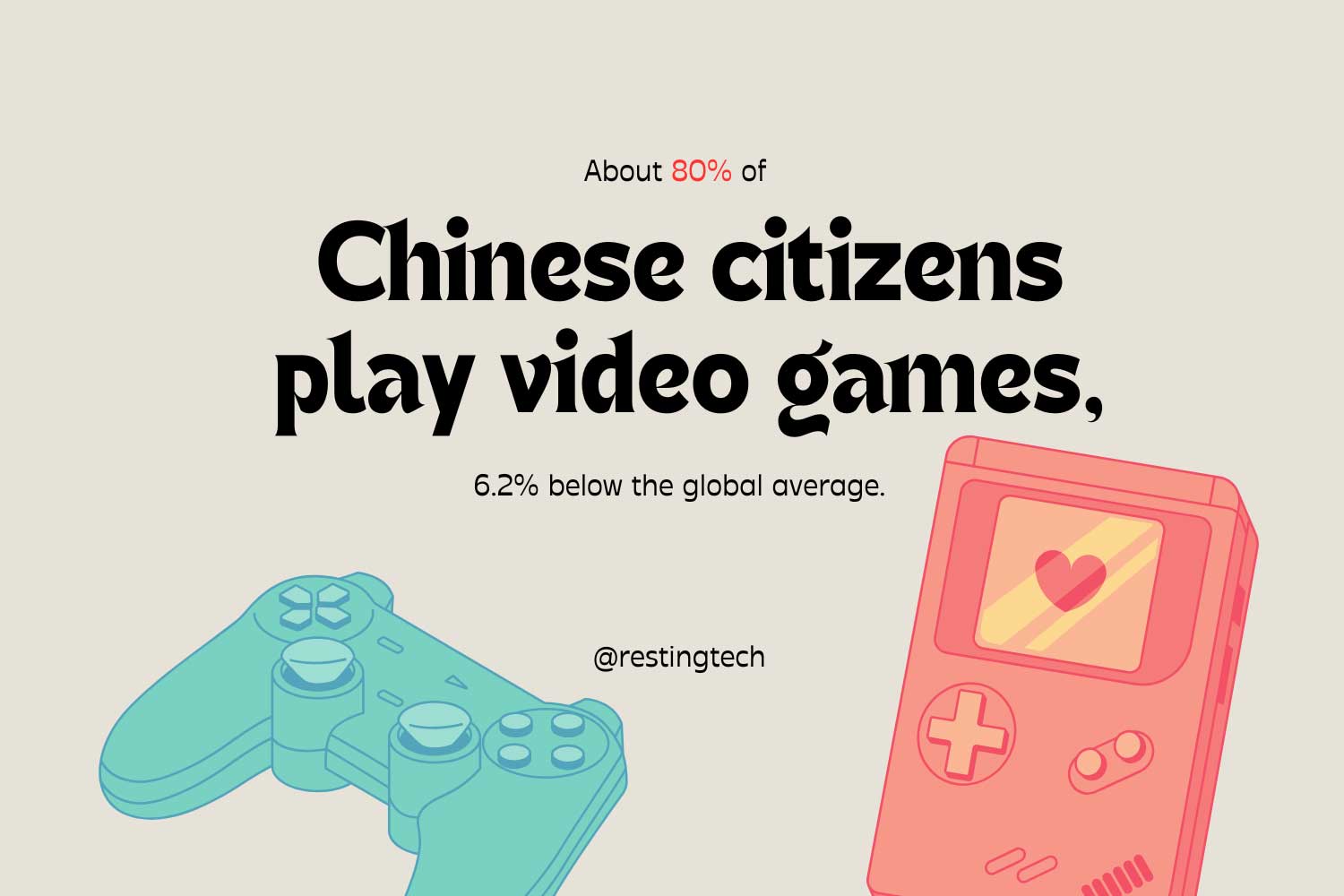
And an average of 1 hour 15 minutes is spent on game consoles – just 3 minutes above the world mean.
Nonetheless, the Chinese government is aiming to crack down on children’s screen time by limiting their play time to three hours per week. That equates to just under 26 minutes per day.
From the available data, Japan and Russia average the closest play time to that figure (30 minutes). And only Israel averages less (19 minutes).
Screen Time by Age
Age is an important factor in screen time consumption. Around 3 in 4 (74%) of parents with a child aged 2 or younger claim their child watches TV.
And 90% of older children spend time watching a TV screen.

Here’s a breakdown of the proportion of children who use certain devices according to the latest research:
| Age | TV | Tablet | Smartphone | Desktop/Laptop | Gaming |
|---|---|---|---|---|---|
| 0-2 years | 74% | 35% | 49% | 12% | 9% |
| 3-4 years | 90% | 64% | 62% | 21% | 25% |
| 5-8 years | 93% | 81% | 59% | 54% | 58% |
| 9-11 years | 91% | 78% | 67% | 73% | 68% |
| Total | 88% | 67% | 60% | 44% | 44% |
Almost across the board, there is a strong positive correlation between age and the proportion of children using a device.
Interestingly, the most passive screen time experience (watching TV) plateaued from the ages of 3-4 years onwards.
Whereas more active, and potentially demanding devices (desktop computers/laptops and gaming consoles) increased at a steady rate with age.
Perhaps unsurprisingly, young people spend more time in front of screens than average. In fact, a recent study revealed that Gen Z spends around 9 hours per day looking at a screen – approximately 2 hours more than the US and global average.

Impact of Screen Time
Data from a survey of 2,000+ US adults revealed that less than half the time spent on screens is believed to be productive. This startling statistic underscores the potential for wasted time and reduced efficiency in our digital-centric lives.
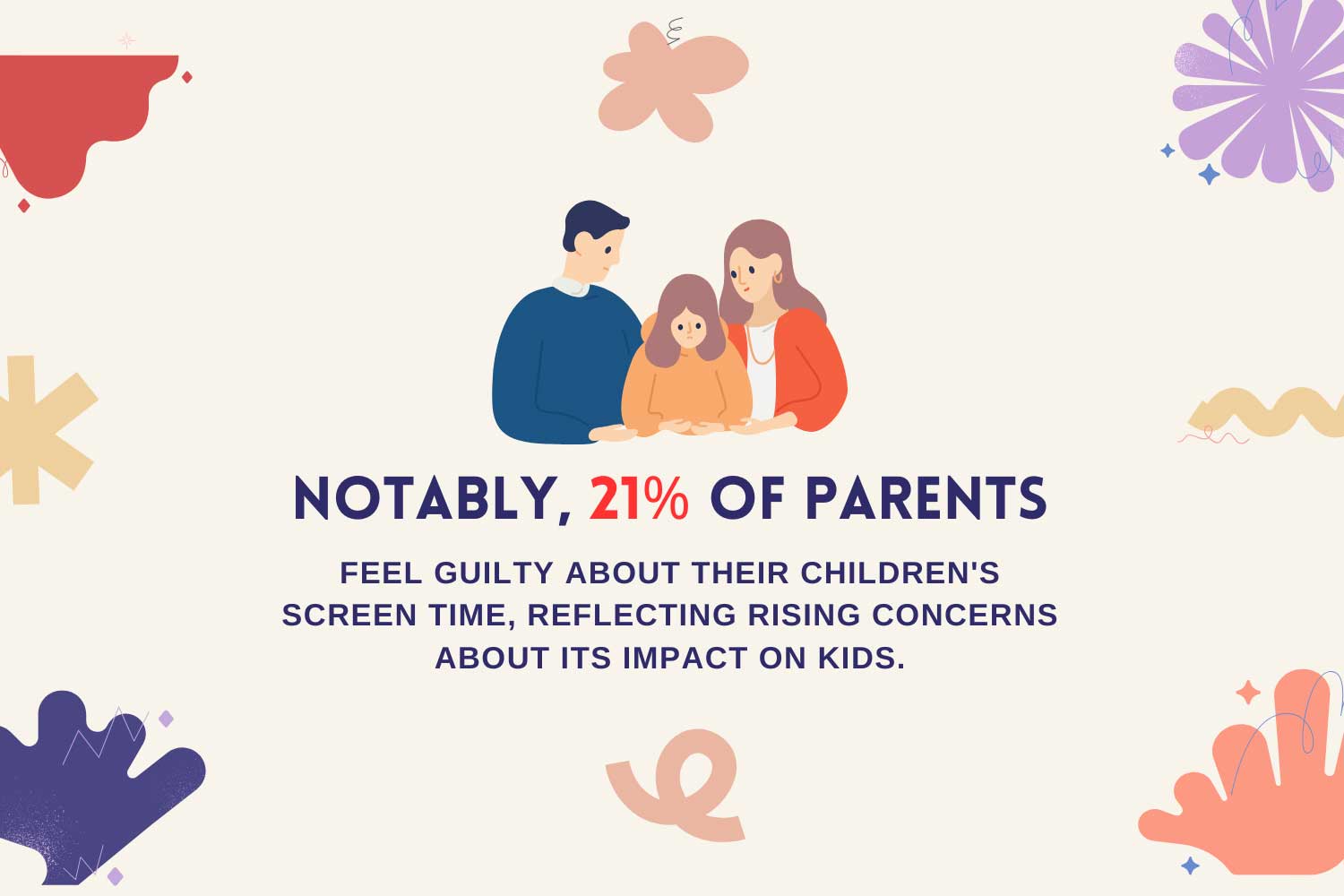
Furthermore, 41% admit to finding screen time management challenging, highlighting a widespread struggle to balance digital engagement with other aspects of life. Even more concerning, 21% of parents feel guilty about their children’s screen time, indicating a growing awareness of the potential negative impacts on younger generations.
Excessive screen time can have significant consequences, particularly for children:
- Elementary-level school children who watch 2+ hours of screen time per day are more likely to suffer from social, emotional, and attentional issues.
- Sleep deprivation is a major concern, as blue light from screens interferes with melatonin production and disrupts the body’s circadian rhythm.
- There’s a strong association between screen time and obesity in children aged 5 to 17, likely due to the sedentary nature of screen viewing.
- Children aged 9 to 10 who spend 3+ hours on screens daily were more likely to show insulin resistance, potentially increasing their susceptibility to Type 2 Diabetes.
- Delayed learning can occur in young children who watch excessive TV, potentially hindering language development.
However, it’s not all negative. Studies have shown no significant correlation between screen time and academic performance. Additionally, in the wider population, limiting social media use to 30 minutes per day has been linked with reduced depression and improved well-being, suggesting that moderation rather than elimination may be key.
The takeaway
In 2024, the average person spends a staggering 7 hours and 20 minutes per day staring at screens, consuming nearly half of our waking hours. This digital immersion, accelerated by the pandemic and technological advancements, has raised legitimate concerns about its impact on our health, productivity, and social interactions.
While technology offers undeniable benefits, moderation is key. The data reveals significant variations across demographics, with Gen Z averaging 9 hours and 45 minutes of daily screen time, and 68% of children under 3 regularly interacting with smartphones or tablets.
It’s crucial to recognize that not all screen time is created equal – the content and context matter just as much as the duration.
Contrary to popular belief, screen time doesn’t necessarily correlate with poor academic performance. However, excessive use can lead to various health issues, including sleep disruption, obesity, and potential mental health concerns.
With 70% of people checking their phones within 5 minutes of waking up, and social media accounting for 2 hours and 27 minutes of daily screen time globally, it’s clear we need to cultivate a healthier relationship with technology.
As we navigate this digital age, let’s strive for balance. Set boundaries, be mindful of your screen habits, and make time for real-world experiences. Remember, technology should enhance our lives, not dominate them.
With 46% of adults already trying to reduce their screen time, we can collectively work towards harnessing the power of screens while preserving our well-being and meaningful human connections.
Please share your thoughts on how screen time impacts your daily life in a single comment below.
Sources
People, AIFS, Mayo Clinical Health System, The Journalist’s Resource, Active Health, Quartz, Data Reportal, Data Reportal, DigitalInformationWorld, PewResearch, Forbes, Comparitech, DataReportal, Reuters, Comparitech, Comparitech, Common Sense Media