Did you know that the average American has $23,325 in debt, excluding mortgages? Personal finance might seem daunting, but understanding the numbers can empower you to make better financial decisions.
In today’s complex economic landscape, many Americans struggle with debt, savings, and financial planning. This stems from a lack of financial education, rising living costs, and evolving economic conditions. However, by examining key financial statistics, we can gain valuable insights into the state of personal finance in the United States.
This article breaks down the most recent and relevant personal finance statistics, covering areas such as net worth, savings, debt, homeownership, and retirement planning.
Whether you’re looking to improve your financial health or simply curious about how you compare to national averages, these numbers will provide a clearer picture of America’s financial landscape.
Key Stats:
- The median net worth for American families in 2019 was $121,760, a more representative figure than the average net worth of $748,800, which is skewed by high-net-worth individuals.
- As of 2019, the median household bank balance was $5,300, slightly higher than the 2016 median of $4,790.
- In 2020, the personal savings rate reached 13.7%, the highest rate on record at that time.
- 42% of Hispanic families and 41% of Black families had an income under $25,000 in 2020, compared to only 21% of white families and 22% of Asian families.
- By the end of 2020, 75% of adults considered themselves to be either financially “doing okay” (40%) or “living comfortably” (35%).
- The average debt for American adults is $23,325 (excluding mortgages), a significant decrease from $29,800 in 2019.
- Collectively, Americans have $1.54 trillion in outstanding student loan debt.
- 82% of bachelor’s degree holders who received payment deferrals or reductions from the CARES Act reported being “at least financially okay”.
- As of 2021, the average credit score in the United States is 711, an all-time high.
- 26% of non-retired adults have no retirement savings.
- In 2020, the average 401(k) account balance was $106,478, up from $92,128 in 2019.
- The median 401(k) account balance for people under age 25 was $1,817 in 2020, while for those 65 and up, it was $64,548.
- Less than 17% of U.S. high school students have a personal finance requirement in their curriculum.
- 86% of Americans think financial education classes in K-12 schools should be mandatory.
- In August 2021, the median sales price of an existing single-family home hit an all-time high of $363,800.
Personal Finance Statistics
American financial statistics can help you understand how the United States is faring and how you are doing financially compared to your peers.
Averages, also known as means, are common personal finance statistics to share. Medians, the middle numbers in an ascending or descending data set, are more useful in some situations and often included.
1. The average net worth for American families in 2019 was $748,800.
The average net worth for families rose steadily until The Great Recession, when it dipped. It then started rising again consistently through 2019.
The Federal Reserve conducts a survey every three years, stating the 2022 information will be available in early 2023 for the next look at the net worth figures for families in America. (Source: Federal Reserve)
2. The median net worth for American families in 2019 was $121,760.
The median net worth tends to show a typical person’s net worth better than the average. This figure is far lower than the average, which includes several outliers strongly skewed toward a select handful of families with billions in wealth. (Source: Federal Reserve)1
3. The average household bank balance is $41,600.

According to 2019 data, the average household bank balance was slightly lower than the 2016 average of $42,580. (Source: Federal Reserve)
4. The median household bank balance is $5,300.
According to 2019 data, the median household bank balance was slightly higher than the 2016 median of $4,790. (Source: Federal Reserve)
5. The conditional median value of all financial assets owned by families was $25,700 in 2019.
This value is slightly up from previous years. (Source: Federal Reserve)
6. The conditional average value of all financial assets owned by families was $363,700 in 2019.
The difference between the mean and median values in the same year shows some families’ highly disproportionate share of financial assets. (Source: Federal Reserve)
7. The conditional average value of stock holdings in 2019 was $373,200.

For people in the lower half of income distributions, the value averaged only $55,800. For earners in the top 10%, the average was $1,505,200. (Source: Federal Reserve)
8. The conditional median value of stock holdings in 2019 was $40,000.
For people in the bottom half of income distributions, the value was about $10,000. For those in the top income decile, the average was almost $439,000 (Source: Federal Reserve)
9. The personal savings rate was 13.7% in 2020 (the highest rate on record).
A personal savings rate is the ratio of money one saves compared to their disposable income (money after taxes). (Source: Statista)
10. On average, Americans have $17,135 in an investment or savings account.
The survey of 5,000 people (100 from every state) found that New Yorkers were the best at saving money. They put an average of 14.5% of income into savings accounts or investment accounts. (Source: PR Newswire)
11. About 13% of families owned a privately held small business in 2019.

The incidence of business ownership increases with income, with nearly 40 percent of families in the top income decile owning a small, mid or large business. (Source: Federal Reserve)
Mortgage & Homeowner Statistics
Current homeowners and anyone considering buying a house in the future benefit from following the housing market and noting how prices rise and fall.
12. Mortgage interest rates hit an all-time low in the United States in 2020.
The 30-year fixed-rate got down to 3%, and the 15-year fixed-rate decreased to 2.3%. (Source: Statista)
13. In 2021, the median sales price of an existing single-family home hit an all-time high.
In August 2021, the median sales price of an existing single-family home was $363,800. (Source: Statista)
14. The value of outstanding mortgage debt on family residences was about $11.78 trillion in the U.S.
The amount of outstanding mortgage debt has been rising since 2015. (Source: Statista)
15. The median net housing value for homeowners in 2019 was $120,000.

This value is a 13% increase from the 2016 median value of $106,400. (Source: Federal Reserve)
Income Statistics
There is no average American household. Financial statistics related to income vary significantly by race, gender, age, and the current state of the economy.
16. In 2020, 28% of people had a household income below $25,000.

About 17% of families had a household income of $25,000-$49,000, 25% had an income between $50,000-$99,999, and 29% had an income of $100,000 or more. (Source: Federal Reserve)
17. 42% of Hispanic families and 41% of Black families had an income under $25,000 in 2020.
Comparatively, only 21% of white families and 22% of Asian families had an income under $25,000. (Source: Federal Reserve)
18. Over 10% of adults got meals or groceries from a food pantry, community organization, or religious organization in 2020.
The less formal education a person has, the more likely they were to receive free meals or groceries. For instance, 30% of people with less than a high school degree received free food, while only 4% with a bachelor’s degree or more did. (Source: Federal Reserve)
19. 67% of adults and their partners received labor income in 2020.
Labor income consists of salaries, wages, and self-employment. 61% of adults and their partners also received non-labor income in 2020, which is 54% higher than in 2019.
Non-labor income can include interest, dividends, rental income, social security, supplemental security income, or unemployment. (Source: Federal Reserve)8
20. In 2020, 14% of adults received unemployment income.
This number was up from 2% in 2019 and directly resulted from the Covid-19 pandemic. (Source: Federal Reserve)
Personal Budget Statistics
One’s budget is a significant factor in personal finance statistics. People living paycheck to paycheck will spend their money differently than those without any consumer debt.
21. 18% of people making over $100,000 annually live paycheck to paycheck.

A survey of 8,000 American employees shows that even high-income earners can be living paycheck to paycheck. (Source: Willis Towers Watson)
22. 64% of American adults could cover an unexpected $400 expense using cash or an equivalent.
Of the 35% of adults who couldn’t cover an unexpected $400 with cash or an equivalent, many said they would put it on a credit card and carry a balance (rather than pay it off right away), and 12% said they would have no means to pay the expense. (Source: Federal Reserve)
23. 60% of laid-off adults with only a high school education or less couldn’t pay all their bills or wouldn’t be able to with an unexpected $400 expense.
Comparatively, only 24% of laid-off adults with a bachelor’s degree education (or higher) wouldn’t have been able to pay bills with an expected $400 expense. (Source: Federal Reserve)
24. 64% of laid-off Black workers couldn’t pay all their bills or wouldn’t be able to with an unexpected $400 expense.
In comparison, only 45% of all laid-off adults wouldn’t be able to cover bills and an unexpected $400 expense. (Source: Federal Reserve)
25. 75% of adults considered themselves to be either financially “doing okay” (40%) or “living comfortably” (35%) by the end of 2020.

The number of people who considered themselves “at least doing financially okay” was steadily rising following the Great Recession. It dipped to 72% when the COVID pandemic hit hard in April 2020.
In July 2020, it rose (likely due to government interventions through stimulus payments, increased unemployment insurance benefits, and more.) It fell back to pre-pandemic levels at the end of 2020. (Source: Federal Reserve)
26. Only 45% of people with less than a high school degree considered themselves “at least doing okay financially” at the end of 2020.
Comparatively, 89% of adults with a bachelor’s degree said to have been at least doing okay financially at that time. (Source: Federal Reserve)
27. In the last several years, the percentage of White and Asian adults “at least doing okay financially” has increased, while it has decreased for Black and Hispanic adults.

By the end of 2020, 84% of Asian adults and 80% of White adults reported they were doing at least financially okay. Only 64% of Black and Hispanic adults said the same. (Source: Federal Reserve)
28. Married people feel more financially stable than unmarried people.
In 2020, 82% of married people considered themselves doing at least okay financially. Only 67% of single people responded the same.
Married couples tend to have the most financial support as there are potentially two wage earners in the household (which can buffer better against a potential layoff). (Source: Federal Reserve)
29. More childless adults felt at least “okay financially” than parents.
In 2020, 78% of adults with no children felt at least financially okay, while only 67% of parents felt the same. (Source: Federal Reserve)
30. People in Metropolitan areas felt better financially than those in non-metro areas by the end of 2020.
76% of metro area people reported being at least okay financially. Meanwhile, only 69% of those in non-metro areas agreed. People in cities have also seen a more significant improvement than those in rural areas. (Source: Federal Reserve)
31. The average American spends less than $20 per month on coffee outside the home

Despite the common personal finance advice to quit spending money on Starbucks coffee, 53% of American adults spend less than $20 per month on coffee at a coffee shop. (Source: Statista)
Average American Debt Statistics
Debt is an integral part of personal finance statistics as it affects nearly every aspect of a person’s life.
32. The average debt for American adults is $23,325 (excluding mortgages).
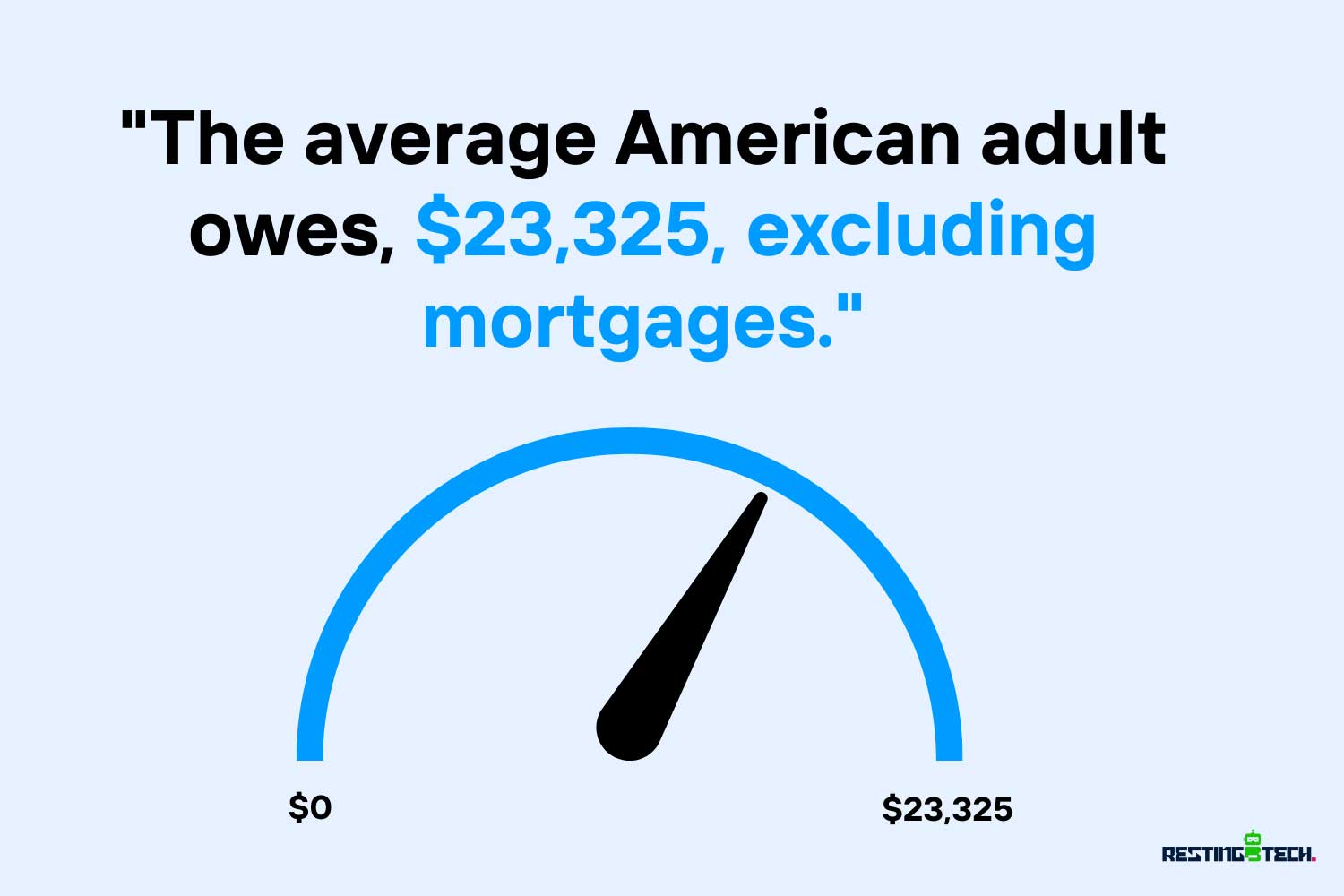
The amount of debt in 2021 went down over 20% since 2019, when the average debt (excluding mortgages) was $29,800. (Source: Northwestern Mutual)
33. On average, 30% of American adults’ income goes towards paying off debt (excluding mortgages).
After mortgages, the top source of debt is to carry credit card debt at 19% of income. Car loans average 8% of income, and student debt is 7%. (Source: Northwestern Mutual)
34. 66% of people with household debt have a plan and timeline for paying it off.

Of debt holders, 45% expect to be in debt for only 1-5 years, 20% for 6-10 years, 14% for 11-20 years, and 9% expect to be in debt for the rest of their lives. (Source: Northwestern Mutual)
35. 29% of Americans report delaying significant purchases because of debt.
About 7% of people delayed marriage, 8% delayed having children, 14% delayed buying a home, and 18% delayed saving for retirement (Source: Northwestern Mutual)
36. 34% of people with debt say it’ll take more time than expected to pay off debt due to the pandemic.

Meanwhile, 23% believe they will pay their debt off sooner. (Source: Northwestern Mutual)
Student Loan Debt Statistics
Student loans significantly affect one’s personal finance statistics. Many consider student loan debt to have a lasting impact on their finances.
37. Collectively, Americans have $1.54 trillion in outstanding student loan debt.
Students loans can be from federal or state governments, banks, credit unions, or other financial institutions. (Source: Federal Reserve Bank of New York)
38. First-generation college students are about 3X more likely to be behind on student loan payments than students with a parent who earned a bachelor’s degree.
Among borrowers under age 40, 16% of first-generation college students were behind on student loan payments in 2020. (Source: Federal Reserve)
39. Black and Hispanic college students are more likely to be behind on student loan payments than White and Asian students.
Among borrowers under age 40, 23% of Black college students and 20% of Hispanic college students were behind on student loan payments in 2020. Comparatively, only 6% of White borrowers and 4% of Asian borrowers were behind.
Some of the reasons for these differences are degree completion rates, wages for education credentials earned, and attended institutions. (Source: Federal Reserve)
40. 26% of students under age 40 who attended private for-profit colleges were behind on student loan payments in 2020.
Only 10% of same-aged students who went to public colleges were behind on payments, and only 5% of private, not-for-profit college students were behind. (Source: Federal Reserve)
41. 82% of bachelor’s degree holders who received payment deferrals or reductions from the CARES Act reported being “at least financially okay.”

In comparison, only 77% of borrowers who didn’t receive any payment relief considered themselves at least financially okay during the same time. (Source: Federal Reserve)
Average Credit Card Debt
While many people fear credit card debt, having credit cards is beneficial to people’s credit scores when used responsibly.
42. On average, Americans have four credit cards.

New Jersey residents have the most credit cards on average (4.1), while Mississippi and Alaska residents have the fewest (2.8). (Source: CNBC)
43. 711 is the average credit score in the United States.
The average credit score has been rising over the last decade and is currently at an all-time high. (Source: Forbes)
44. 83% of adults owned a credit card in 2020.
It was more common to have a credit card at higher income levels than at lower income levels. It was also more popular to have a credit card if you were white (87%) or Asian (92%) than Hispanic (76%) or Black (72%). (Source: Federal Reserve)
45. 41% of Black adults were denied credit in 2020.
Only 9% of Asian adults were denied credit. This pattern consists of all income levels. (Source: Federal Reserve)
46. Generation X has the highest average credit card debt out of all generations.
The average credit card debt among Generation X members is $7,155. (Source: Federal Reserve)
47. Generation Z consumers have an average credit card balance of $1,963.
Generation Z has the lowest credit card debt, at least partially due to young cardholders’ lower credit limits. (Source: Federal Reserve)
Retirement Savings Statistics
Personal finance statistics about retirement can help people understand how much they need to save for the future.
48. 27% of adults considered themselves retired in 2020, despite some still working in some capacity.

13% of retired people had done some work for profit in the month before the survey. (Source: Federal Reserve)
49. 26% of non-retired adults have no retirement savings.
Additionally, only 36% of adults in 2020 considered themselves on track for retirement.
Unsurprisingly, people aged 18-29 were least likely to have retirement savings (62%), while people aged 60 and over were most likely to have retirement savings (87%).
50. Compared to men, women with a bachelor’s degree are about half as likely to feel comfortable investing in self-directed retirement savings.

60% of men with a bachelor’s degree or more feel mostly or very comfortable investing in self-directed retirement savings. Only 31% of women with the same education feel comfortable doing so.
The less education completed for both men and women, the less likely they were to feel comfortable investing self-directed retirement savings. (Source: Federal Reserve)
51. The average 401K account balance was $106,478 in 2020.
According to Vanguard data from 5 million accounts, this number is up from $92,128 in 2019. (Source: Business Insider)
52. The median 401K account balance was $25,775 in 2020.

Account balances increase with income level and age. They also vary by gender and industry. (Source: Business Insider)
53. The median 401K account balance for people under age 25 was $1,817 in 2020.
By age 65 and up, the median was $64,548. (Source: Business Insider)
54. The average IRA balance was $134,700 in Q3 of 2021.
According to data from Fidelity, this is a slight increase from both the previous quarter and Q3 from 2020. (Source: Business Wire)
55. 35% changed their retirement timeline due to Covid-19.
About 24% plan to retire later than initially planned, and 11% plan to retire earlier. (Source: Northwestern Mutual)
Financial Literacy Statistics
Financial education can significantly help people build their wealth. Still, it isn’t always easy to access basic financial literacy information at a young age.
Personal finance statistics show that most people believe in the importance of financial literacy. Still, there are few school requirements to learn about finance.
56. Less than 17% of U.S. high school students have a personal finance requirement.

Nearly 70% of high schoolers have the option of taking at least one semester of personal finance, but less than 17% are required to take one. (Source: Council for Economic Education)
57. Only 24 states require a high school personal finance course to be offered.
Washington D.C. and 26 U.S. states don’t require high schools to offer a personal finance class. (Source: Council for Economic Education)
58. 61% of Americans believe their parents are a vital influence in managing their finances.

More Americans turn to their parents for financial advice than they turn to their spouse/partner, internet websites and blogs, financial advisors, or school classes. (Source: PR Newswire)
59. 46% of parents with children under age 21 would give their financial literacy a grade of C or lower.
55% of parents reported feeling confident about taking out student loans and paying off student loan debt, 61% about retirement planning, and 53% about managing a 401K. Only 33% felt confident investing in the stock market. (Source: PR Newswire)
60. Only 52% of Americans report having had personal finance education in K-12 or college.
Personal finance stats also show only 15% of students felt “very prepared” to manage personal finance after college. (Source: PR Newswire)
61. 86% of Americans think financial education classes in K-12 schools should be mandatory.
Only 9% of parents had discussed managing student loans with their children, and only 13% talked about planning for retirement. Classes teaching financial statistics and strategies could help educate more children. (Source: PR Newswire)
The takeaway
Key insights from these statistics include the persistent wealth gap between racial groups, the widespread struggle with debt and savings, and the critical need for improved financial education.
For instance, the median net worth for American families ($121,760) paints a more realistic picture than the average, which is skewed by high-net-worth individuals. Additionally, the fact that 26% of non-retired adults have no retirement savings highlights a pressing concern for future financial stability.
A common misconception is that financial struggles only affect low-income individuals. However, statistics show that even 18% of people making over $100,000 annually live paycheck to paycheck. This underscores the importance of financial literacy and smart money management across all income levels.
Ultimately, these statistics serve as a call to action for both individuals and policymakers. By improving financial education, addressing wealth disparities, and promoting sound financial practices, we can work towards a more financially secure future for all Americans.
Remember, understanding these numbers is the first step towards taking control of your financial health. The fact that 86% of Americans think financial education classes in K-12 schools should be mandatory shows a growing recognition of this need.
These personal finance statistics offer a comprehensive snapshot of Americans’ financial health, highlighting both challenges and opportunities for improvement across various demographics and income levels.
Citations:
Federal Reserve Survey of Consumer Finances, Federal Reserve Changes in U.S. Family Finances, Statista Personal Savings Rate in the United States, PR Newswire Savings, Statista Mortgage Interest Rates, Statista Home Prices, Statista Mortgage Debt, Federal Reserve Report on Economic Well-Being, Statista, Willis Towers Watson, Northwestern Mutual, Federal Reserve Bank of New York, CNBC Credit Card Numbers, Forbes, Federal Reserve Bank, Business Insider, Business Wire, Council for Economic Education, PR Newswire Financial Guidance